History IELTS Speaking Part 1: Sample Questions, Answers & Vocabulary
Boost your score with History IELTS Speaking Part 1 sample questions, band 8 answers, and topic-specific vocabulary. Learn how to meet key IELTS speaking band descriptors naturally.
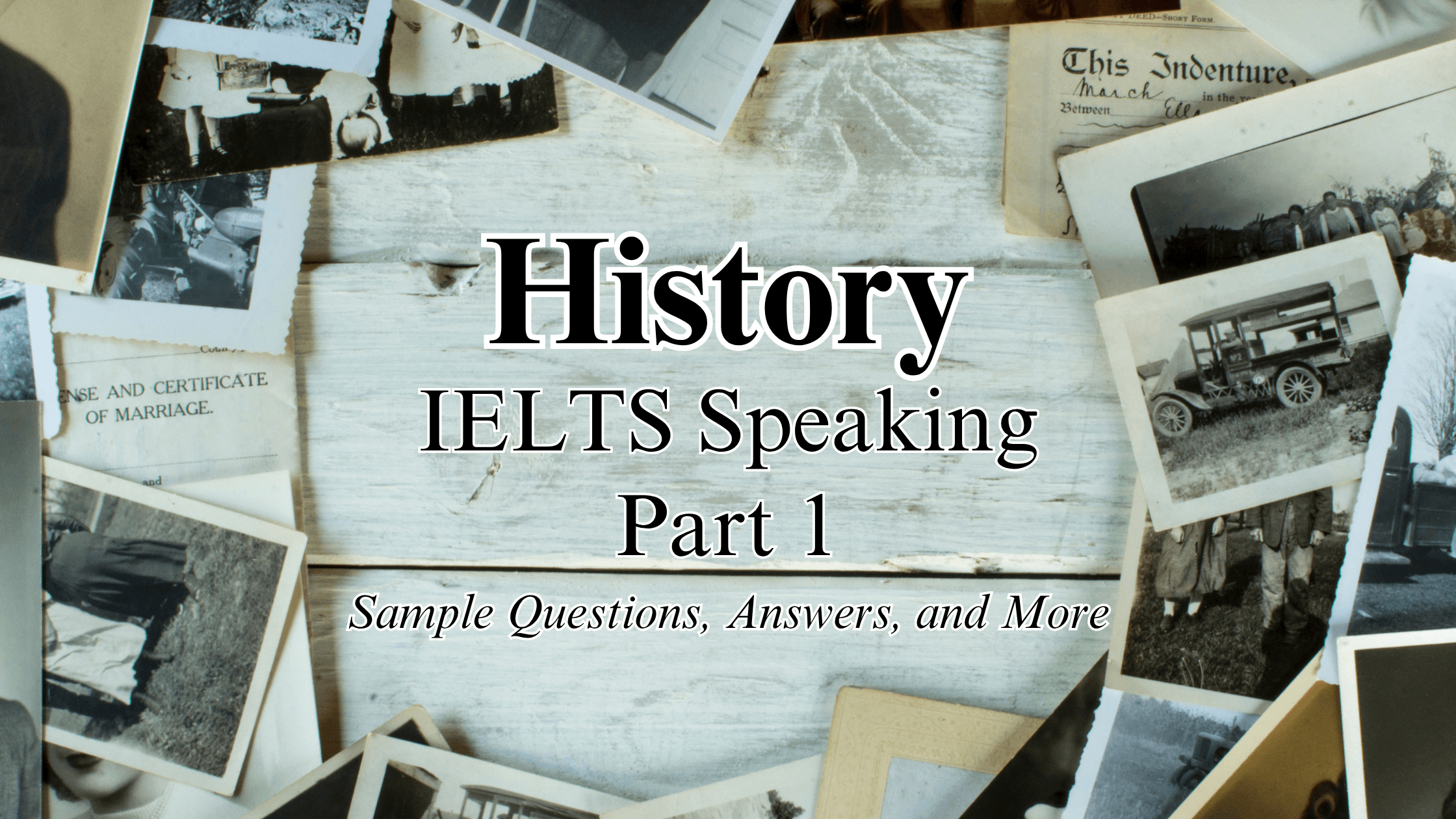
While many students expect casual topics like food or hobbies, history is another frequent theme in IELTS Speaking Part 1. You may be asked about history classes, national heroes, or how interested you are in the past.
Good news: You don’t need to be a historian. All you need is a clear, personal answer with solid vocabulary and fluency.
This guide will help you prepare with sample History IELTS Speaking questions, Band 8 answers, and useful words and expressions to sound more confident.
IELTS Speaking Part 1 Questions – History Topic
Here’s a list of common questions related to history:
- Do you like learning about history?
- Did you enjoy history classes at school?
- What kind of historical events are you most interested in?
- Have you ever visited a historical place?
- Do you think history is important to learn?
- What historical figure do you admire?
- Is history popular in your country?
Band 8 Sample Answers
1. Do you like learning about history?
“Yes, I do. I’ve always found it fascinating to learn how past events have shaped the world we live in today. History helps me understand different cultures, conflicts, and even modern politics.”
2. Did you enjoy history classes at school?
“Actually, yes. My history teacher made the lessons really engaging by using documentaries and group discussions instead of just textbooks. I especially enjoyed learning about ancient civilizations and world wars.”
3. What kind of historical events are you most interested in?
“I’m particularly interested in events related to the Vietnam War and World War II. These had a huge impact on my country and the world. It’s interesting to learn how people survived and what decisions shaped global politics.”
4. Have you ever visited a historical place?
“Yes, I once visited the Imperial City in Hue. It was incredible to see such well-preserved architecture and imagine what life was like centuries ago. The guide also shared stories about Vietnamese royalty, which made it even more interesting.”
5. Do you think history is important to learn?
“Absolutely. History teaches us valuable lessons about human behavior, mistakes, and progress. Without understanding the past, we might repeat the same errors in the future.”
Vocabulary for History IELTS Speaking
Here are some topic-specific words and phrases you can use in your answers:
🔹 People & Events
- Historical figure
- National hero
- Civil war / World War
- Revolution / Independence movement
- Ancient civilization / Empire
🔹 Describing Interest in History
- Fascinating / Thought-provoking
- Learn from the past
- Understand different cultures
- Historical significance / Impact
- Time period / Era
🔹 Places & Learning Tools
- Museum / Historical site / Landmark
- History book / Documentary / Archive
- Field trip / Guided tour
- Timeline / Artifact / Exhibit
Practical Tips to Boost Your Band Score
Want to sound like a Band 8+ candidate when discussing history? Here's how to apply the official IELTS speaking band descriptors in a smart, topic-specific way:
1. Fluency & Coherence
What it means: Speak smoothly, logically, and without unnatural pauses. Stay on topic and use connectors.
What to do for history questions:
- Don’t just say “yes” or “no” – explain why.
- Use personal stories or examples from school or travel.
- Connect ideas: use “because,” “so,” “for example,” “in fact.”
Sample Upgrade:
Q: Did you enjoy history in school?
❌ “Not really. It was boring.”
✅ “Not really. It was mostly textbook-based and focused too much on memorizing dates, which I found quite dull. But I did enjoy the lessons about ancient Egypt because I love learning about different cultures.”
2. Lexical Resource (Vocabulary)
What it means: Use a variety of accurate, topic-specific words and phrases.
What to do for history questions:
- Replace basic words like “old” with “ancient,” “historical,” “classical.”
- Use terms like “historical figure,” “national hero,” “colonial period,” “landmark event.”
- Describe feelings: “thought-provoking,” “inspiring,” “tragic,” “eye-opening.”
Sample Upgrade:
Q: Have you visited any historical places?
❌ “Yes, it was an old building.”
✅ “Yes, I visited the Imperial City in Hue, which is a well-preserved complex from the Nguyen Dynasty. It gave me a deeper appreciation for Vietnam’s royal history.”
3. Grammatical Range & Accuracy
What it means: Use a mix of sentence types and tenses accurately.
What to do for history questions:
- Use past tenses for events and memories: “I visited,” “I learned,” “We were taught…”
- Use present simple for general opinions: “History helps us understand today’s world.”
- Try complex sentences: use “although,” “because,” “even though,” “so that.”
Sample Upgrade:
Q: What kind of historical events are you interested in?
“Although I’m not deeply into politics, I find revolutions fascinating because they show how ordinary people can shape history.”
4. Pronunciation
What it means: Speak clearly, with correct stress and intonation.
What to do for history questions:
- Practice saying long words like “archaeology,” “civilization,” “independence,” “military strategy.”
- Emphasize key content words for clarity: “The war had a huge impact on the region.”
- Pause naturally—especially after ideas, not every word.
Tip: If you struggle with certain words, say them out loud 5–10 times in front of a mirror or while recording yourself. Use slow repetition, then build up to natural speed.
History Repeats, But Your Score Doesn’t Have To
History is an easy topic to prepare for if you know what kinds of questions to expect. Focus on giving full, natural responses with specific examples, whether you're talking about a museum trip, your favorite historical figure, or why history matters.
Need help practicing? LingoLeap’s IELTS Speaking AI Tutor gives you feedback on fluency, vocabulary, grammar, and pronunciation—just like a real examiner.
👉 Start your free trial at LingoLeap and turn your IELTS past into a Band 8 future!