Wild Animals: IELTS Speaking Part 1 Questions, Band 8 Sample Answers, and Vocabulary
Master wild animals IELTS speaking part 1 with two-sided analyses, Band 8 model answers, and topic vocabulary. Your practical guide to IELTS animals speaking and IELTS speaking topics and answers.
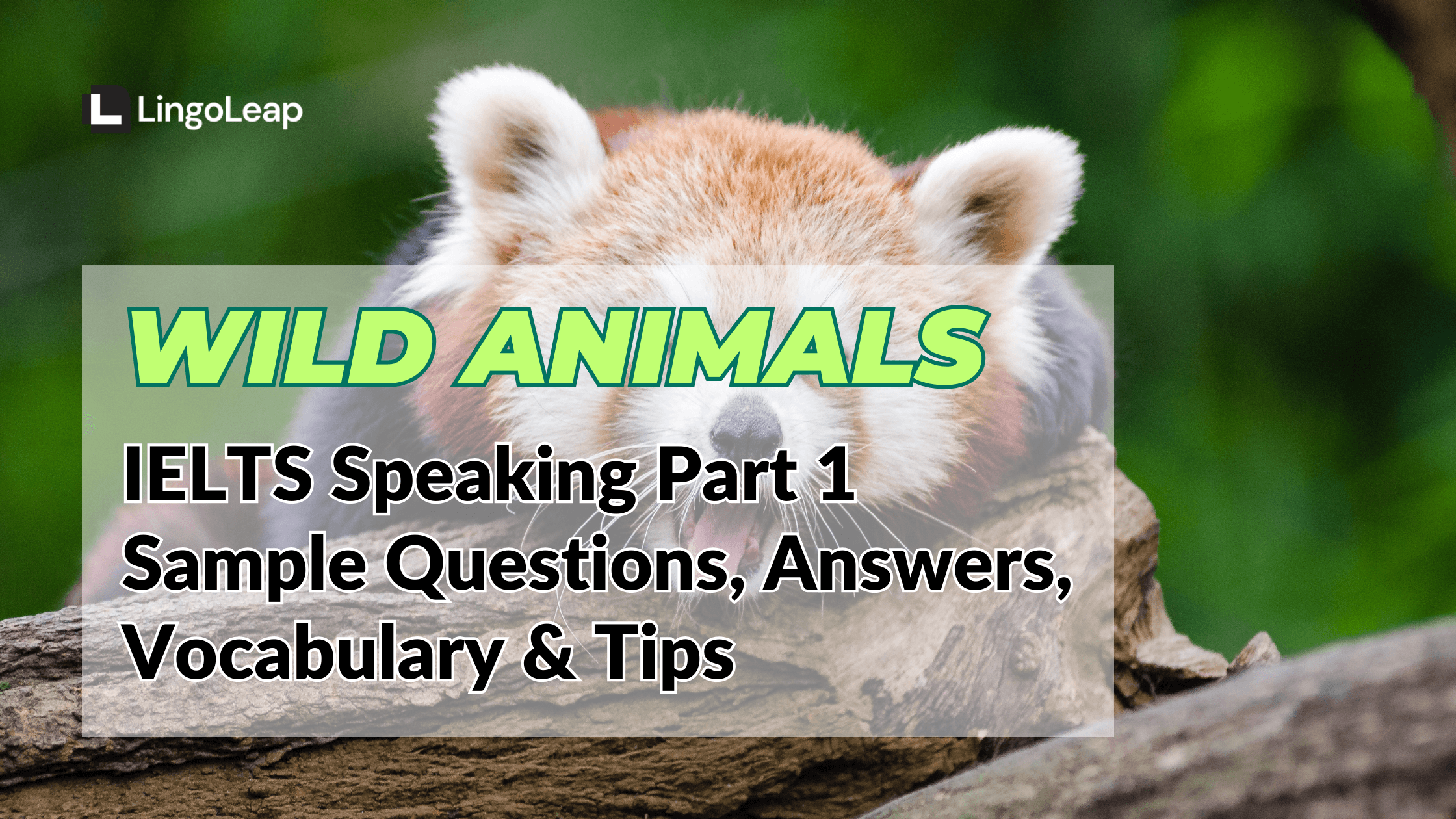
Animal topics appear very often in IELTS Speaking Part 1. Good news: they’re friendly, familiar, and perfect for showing natural language. This guide gives you a detailed breakdown of sample questions, Band 8 model answers, topic vocabulary, and quick tips.
I) How to Analyze the Wild Animals Topic in IELTS Speaking Part 1?
Below, each question includes:
- If you agree/like (Pros) — angles, useful vocab, example ideas
- If you disagree/dislike (Cons) — angles, useful vocab, example ideas
- Band 8 model answers from both perspectives
1. Do you like wild animals?
If you agree / like (Pros)
- Curiosity & wonder: “fascinating,” “majestic,” “unpredictable behavior,” “adaptations”
- Learning value: documentaries, conservation stories, biodiversity awareness
- Cultural symbols: national animals, folklore, tourism highlights
- Personal habit: watching nature channels, visiting wildlife sanctuaries
- Example angle: “I loved the migration episode about wildebeests—unreal scale.”
If you disagree / dislike (Cons)
- Safety concerns: unpredictability, dangerous encounters, “keep a respectful distance”
- Ethical concern with humans around wildlife: feeding, disturbing habitats
- Allergies or fears: phobias (snakes, spiders), discomfort with insects
- Preference for pets: prefer “predictable, affectionate, domesticated” animals
- Example angle: “A close encounter with a boar while hiking made me more cautious.”
Band 8 Model Answers
- Agree: “Yes, absolutely. Wild animals fascinate me because their behavior isn’t staged. I often watch nature documentaries and learn about their survival strategies, which makes me appreciate biodiversity even more.”
- Disagree: “Not really. They’re beautiful, but I’m wary of their unpredictability. I once had a frightening hike when a wild boar appeared on the trail, so I feel safer admiring wildlife from a distance, like in documentaries.”
2. Have you ever seen a wild animal in real life?
If you say yes (Pros)
- Travel memory: national park, safari, coastline, mountains
- Contrast with zoos: natural behavior, authentic environment
- Personal growth: respect for nature, awareness of conservation
- Emotional detail: awe, excitement, “once-in-a-lifetime moment”
- Example angle: monkeys, deer, dolphins, whales, birds of prey
If you say no (Cons)
- Urban lifestyle: limited access to natural habitats
- Ethical choice: avoid captive encounters; prefer virtual tours
- Safety & cost: safaris are expensive; safety concerns
- Alternative learning: “I learn through documentaries and museum exhibits.”
- Example angle: “City life means more pigeons than panthers.”
Band 8 Model Answers
- Yes: “Yes. I visited a national park and saw deer crossing a river at dawn. Their behavior felt completely different from what I’d seen in zoos, and it gave me a deeper respect for protected habitats.”
- No: “No, I haven’t. I live in a dense city, so my exposure to wildlife is mostly through documentaries. It’s surprisingly educational, and I appreciate that it doesn’t disturb animals in their natural environment.”
3. What is your favorite wild animal?
If you choose one (Pros)
- Symbol & meaning: pandas = peace, tigers = strength, elephants = memory/family bonds
- Unique traits: camouflage, migration, “apex predator,” “nocturnal”
- Conservation angle: endangered status, protection programs
- Personal link: native to region, childhood toy/book, a memorable documentary
- Example angle: panda, snow leopard, sea turtle, orca, eagle
If you avoid picking a favorite (Cons / alternative stance)
- Hard to choose: value biodiversity; appreciate variety instead of ranking
- Ethical position: dislike “favorites” if it distracts from protecting all species
- Contextual preference: depends on habitat; “desert species vs. rainforest species”
- Example angle: “Instead of one favorite, I admire how different species fit their habitats.”
Band 8 Model Answers
- Pick one: “The panda is my favorite. It’s rare, gentle, and culturally significant where I’m from. Conservation efforts around pandas also remind me that public awareness can actually save species.”
- Avoid picking: “I don’t really have one favorite. I’m more fascinated by how diverse species adapt to different environments—from desert foxes to polar bears. That variety is what I find inspiring.”
4. Are there any wild animals in your country?
If you say yes (Pros)
- Geography & range: forests, wetlands, mountains, coastlines
- Flagship species: tigers, leopards, elephants, bears, eagles, marine mammals
- Local pride: national parks, biodiversity hotspots, eco-tourism
- Conservation progress: protected areas, anti-poaching efforts, community programs
- Example angle: “In the northeast, we have…; along the coast, we see…”
If you say limited or declining (Cons)
- Threats: deforestation, urban sprawl, illegal hunting, climate change
- Human–wildlife conflict: crop damage, livestock loss, safety incidents
- Fragmented habitats: roads, railways, fencing, mining
- Need for policy & education: corridors, stricter enforcement, public awareness
- Example angle: “Numbers are shrinking, so sightings are rare outside reserves.”
Band 8 Models Answers
- Yes: “Yes. We have a surprising range—mountain forests with leopards, coastal areas with sea turtles, and wetlands full of migratory birds. National parks have improved protection, so certain populations are slowly recovering.”
- Limited: “Only a limited number. Rapid urban development has fragmented habitats, so most wild animals survive mainly in protected areas. Without tighter enforcement and wildlife corridors, it’ll be hard for their numbers to rebound.”
5. Do you think children should learn about wild animals?
If you agree (Pros)
- Early awareness: empathy, responsibility, environmental ethics
- Interdisciplinary learning: science, geography, culture, storytelling
- Practical outcomes: recycling habits, volunteerism, support for conservation
- Engagement tools: school trips, documentaries, interactive apps
- Example angle: “Children who learn early tend to respect animals and habitats.”
If you disagree / prefer limits (Cons)
- Curriculum balance: prioritize literacy/numeracy; not overemphasized
- Age-appropriate content: avoid frightening or graphic materials
- Local relevance: teach about local ecosystems first; avoid superficial “animal facts”
- Quality concern: ensure scientific accuracy, avoid myths/anthropomorphism
- Example angle: “Teach it thoughtfully, not as random trivia.”
Band 8 Model Answers
- Agree: “Yes. Learning about wild animals helps children develop empathy and understand ecosystems. With well-designed lessons and documentaries, they can build lifelong habits that support conservation.”
- Disagree/limit: “To some extent. It’s valuable, but it should be age-appropriate and balanced with other priorities. I prefer lessons that focus on local habitats so children can relate what they learn to real places.”
II) More IELTS Animals Speaking Part 1 Questions
These often appear alongside wild-animal questions. Keep your answers short, personal, and specific.
A) Do you like pets?
- Pros/Like: companionship, stress relief, responsibility, routine, social connection
- Model: “Yes, I grew up with a cat. Caring for her taught me responsibility, and her presence was calming when I studied.”
- Cons/Dislike: allergies, time/cost, housing rules, travel restrictions
- Model: “Not really. I’m allergic to fur, and my apartment doesn’t allow pets, so I’d rather spend time with friends’ animals occasionally.”
B) Do you think zoos are important?
- Pros: education, research, breeding programs, public awareness, funding for conservation
- Model: “Yes, if they provide spacious, natural enclosures and support genuine conservation, they can educate people who’d never see these species.”
- Cons: welfare concerns, stress in captivity, ethical issues, commercial priorities
- Model: “I’m not keen on traditional zoos. Without high welfare standards, animals can suffer. I prefer sanctuaries or responsibly managed reserves.”
C) Should people protect endangered animals?
- Pros: biodiversity, ecosystem balance, moral responsibility, cultural heritage
- Model: “Definitely. When keystone species vanish, entire ecosystems destabilize, so protection is essential.”
- Cons (rare stance): resource priority (human needs first), cost-effectiveness, focus on habitats rather than species
- Model: “Resources are limited, so I’d focus on protecting habitats. That way, multiple species benefit at once.”
III) Vocabulary for Wild Animals & Animal Topics
- Habitat (n.) the natural home of an animal. Tigers need a large habitat to thrive.
- Endangered (adj.) at risk of extinction. Pangolins are endangered due to poaching.
- Extinct (adj.) no longer existing. The dodo is extinct.
- Conservation (n.) protection of wildlife and habitats. Conservation projects rely on public support.
- Poaching (n.) illegal hunting. Anti-poaching patrols protect rhinos.
- Biodiversity (n.) variety of life in an ecosystem. Rainforests have rich biodiversity.
- Predator (n.) animal that hunts others. Wolves are natural predators.
- Prey (n.) animals hunted by predators. Rabbits are common prey for foxes.
- Nocturnal (adj.) active at night. Owls are nocturnal birds.
- Camouflage (n./v.) color/pattern to blend in. Chameleons camouflage to avoid predators.
- Apex predator (n.) top of the food chain. Orcas are apex predators.
- Keystone species (n.) species critical to ecosystem balance. Sea otters are a keystone species in kelp forests.
- Captivity (n.) kept in a controlled environment. Some animals struggle in captivity.
- Wildlife corridor (n.) route that connects habitats. Corridors help animals migrate safely.
- Human–wildlife conflict (n.) clashes over space/resources. Farms near reserves can face human–wildlife conflict.
- Domesticated (adj.) adapted to live with humans. Dogs are domesticated animals.
- Sanctuary (n.) safe place for rescued animals. The sanctuary rehabilitates injured birds.
- Rehabilitation (n.) restoring health/skills to return to the wild. Turtles undergo rehabilitation before release.
- Ethology (n.) study of animal behavior. Ethology helps improve welfare in zoos.
IV) How to Answer IELTS Speaking Part 1 Animals Topic?
1) Use a tiny structure: Opinion → Specific example → Reason/outcome
“Yes, I do. I love watching penguin documentaries because their social behavior is so complex—it makes me appreciate conservation.”
2) Keep it short but rich: 2–4 sentences with one good example.
3) Vary vocabulary: creature, species, wildlife, habitat, sanctuary, conservation.
4) Show balance: even if you agree, mention one limit (e.g., safety, ethics).
5) Use softeners: I’d say… / I tend to… / From what I’ve seen…
6) Avoid overclaiming: Don’t say “always/never”; try “generally/mostly.”
7) Finish with a why: tie your answer back to learning, safety, or respect for nature.
For more practice sets, browse IELTS speaking topics and answers and check the IELTS band descriptors guide to understand how examiners score fluency, vocabulary, grammar, and pronunciation.
V) How to Practice for Wild Animals (Copy & Speak)
Q1. Do you like wild animals?
- Yes-angle: curious, majestic, documentaries → respect biodiversity
- No-angle: safety concerns, prefer pets → admire from a distance
Q2. Have you seen one in real life?
- Yes-angle: national park memory → authentic behavior
- No-angle: city life, prefer virtual learning → non-intrusive
Q3. Favorite wild animal?
- Pick one: traits + conservation + culture
- No favorite: celebrate biodiversity; different habitats
Q4. Wild animals in your country?
- Yes-angle: habitats + flagship species + parks
- Limited: threats + conflict + need for corridors
Q5. Should children learn about them?
- Yes-angle: empathy + science + lifelong habits
- Limit: age-appropriate + balanced curriculum + local focus
Ready to Boost your IELTS Speaking Score?
Start a free trial on LingoLeap—practice with:
- Instant AI speaking feedback (fluency, grammar, vocabulary)
- Band-style estimates and personalized suggestions
- A large bank of IELTS Speaking topics with model answers
- Timed practice that matches exam conditions
Learn smarter, improve steadily, and speak with confidence on test day!